
For even more on E.E. Nichols see our note here. And you can read all about Peppermint Flat. For all our stories on Salem vice, see here.
 Murders! Hangings! Lost burial grounds! Ruins! Wine!
 The press focused on the great story of the cemetery's discovery, but in the process flattened out some of the history. As is so often the case with real history, the legacy is complicated, and it turns out the homestead may be more interesting as a crucible of 19th century race relations and religiosity here than as a pioneer land claim or a forgotten burial ground. Daniel Waldo was, the Dictionary of Oregon History says, "a man of forceful but liberal views, independent, but sometimes critical and acid in opinion," and it's a shame there isn't more published history about him and those around him. He's something of a mystery.
 The house was not difficult to find, but it is right in the middle of a new vineyard. The slender vines held grapes very small and green, the vines likely in third or fourth leaf. The road was gated and we stood outside. A few of the gentle eminences looked like candidates for the cemetery.
 The house, it turns out, has been abandoned for well over 60 years. The library's photo collection dates this Ben Maxwell photo from 1947.* Even then the house looks abandoned, and there is scaffolding on entry and on the right.
 42 years before that, it seemed to be in ok shape. After a visit in 1905, T.T. Geer, Governor of Oregon from 1899-1903, said the house was "still in a splendid state of preservation." Geer dated the house to 1856, but a few years later in 1911 Geer said that the house was built in 1853. In any event, it replaced a log cabin finished about a year after Waldo had first claimed his land in the fall of 1843.
Dan Waldo was a member of the last Legislative Committee which met before the organization of the provisional government. It held its sessions “at the house of Mr. Hathaway,” in Oregon City, in June, and again in December, 1844. Among his seven colleagues were numbered Peter H. Burnett, M. M. McCarver, A. L. Lovejoy and Robert Newell — all men of sterling character, in whose integrity no man failed to place the fullest confidence, and fitted by nature as well as by experience to accomplish great things.Though he was a pioneer of 1843, he furnished loans for the Cayuse War and the Willamette Woolen Mills, and Geer observed Waldo "was in affluent circumstances from the start."
Mr. Waldo at an early day engaged in many branches of business which had for their object not only his own financial gain, but the development of the country. Chief among them was the Willamette Woolen Mills Company which, established at Salem in 1857, was the first business of its kind in the Northwest. The last few years of his life were spent in Salem, where he died about 1880, after a painful and lingering illness. He lives in the memory of Oregonians as one of the best and most enterprising of her early pioneers a splendid type of the frontiersman.
 Still, Waldo doesn't seem to have merited much biography - the usual places, like Gaston's Centennial History of Oregon (4 vols) are silent. Even Oregon Historical Quarterly doesn't have much. In an Oregonian obituary from September 11th, 1880, James Nesmith said
Mr. Waldo possessed a remarkable vigorous mind, and he was well read in history. The amusing and immortal satires of an older civilization, as presented by Miguel Cervantes in "Don Quixote", he knew by heart. They were adapted to a practical mind like his, which had no patience with cant, shams, pretenses, hypocrisy or hum bugs.It seems we are dealing a complicated and independent, perhaps even eccentric and difficult, character, one whose love of satire might not always have endeared him to his neighbors and even to his friends.
 Daniel Waldo's direct involvement in Salem's first marriage of African-Americans is unclear. But on January 1, 1863, the Reverend Obed Dickinson performed the marriage of Richard Bogle and America Waldo.
They had a feast and Jo [Watt] presided at the table. At it were the whites named and six niggers - three bucks and three wenches. "Am I not a man and a brother?" It was negro equality sentiment mixed up with a little snob-aristocracy. The "first circle" character of the whites was expected to give eclat to the affair and bar all remarks. But it has caused a good deal of gossip and generally [is] regarded as shameful by the community.On January 31st, a writer in the Oregonian noted
It appears that some ladies and gentlemen attended the marriage of a colored girl who had long been a servant and a great favorite in a family at Salem. This circumstance induced an anonymous blackguard to rush into print about the danger of negro equality.With or without Daniel Waldo's patronage or support, the Bogles did not stay around Salem for very long.
Despite being a former slaveholder, Daniel Delaney had a reputation of being friendly with blacks. In 1865, after a dispute about some cattle, some of Delaney’s neighbors took advantage of this; they blackened their faces and went to kill Delaney, hoping that the authorities would pin the crime on blacks.
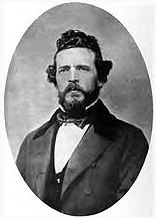 George Beale and George Baker were arrested. In 1945 about the trial and execution Ben Maxwell wrote:
Marion county grand jury indicted Beale and Baker for murder in the first degree. Their trial opened March 20, 1865. Judge Ruben P. Boise presided. [Richard] Williams and [Rufus] Mallory were the prosecutors. David Logan, assisted by Caton and Curl of Salem defended. It was a battle of the giants in early Oregon pleading. Reputations were enhanced. Williams soon entered congress. Mallory later....It's not clear from this and other accounts whether Waldo self-identified as an atheist, an other unbeliever, or perhaps, wishing to point out religious hypocrisy, even thought of himself more authentically Christian than conventional church-goers. In any event, if his relation to slavery was complicated, it seems his relation to Christianity was also complicated.
Beale and Baker stood upon the scaffold facing a multitude. If they were repenant they did not show It. Mrs. Josie Delany LaFore, then a child of 12 and a granddaughter of old man Delaney, recalled that one of them, just before swinging into eternity, tried to spit upon William Delaney, one of the old men's sons.
Hawker's cries interrupted the last thoughts of Beale and Baker. A few days before the execution both confessed and tried to fix the blame on one another. Frederick G. Schwatka a printer, seized upon the confession as a business opportunity and was selling his documents to the crowd as a souvenir....
In death Beale and Baker had small interest for the spectators, who silently slipped halters and drove away. A few remained to arrange disposal of the bodies. No church warden was anxious to receive them within the sacred precincts of their cemetery. Baker's relatives, some commentators relate, claimed his remains and removed them to a family plot.
Beale's body remained unclaimed. His family did not desire it. Then Daniel Waldo, for whom the Waldo Hills were named, said that he, because he did not profess to be a Christian like those present, would provide decent burial for Beale’s body.
Waldo loaded the box into his wagon and drove to his home in the Waldo Hills. There he buried Beale on a hillside and built a rail fence around the grave. Now the fence has fallen away but inquiring persons who travel southward on the highway between MaCleay and Shaw may still see the old, thorny unkempt white rose that seasonally blooms on the grave of George Beale.
 Newspapers don't seem to have anything for 1894, but the Willamette Farmer of May 9th, 1884 contains a story about the murder of David Swartz.
A TERRIBLE TRAGEDY NEAR SALEM
The people of Marion county are excited over a murder trial of unusual interest, because it occurs near Salem and involves the death of an old pioneer and well-known citizen, though he has been accused of great cruelty and unkindness to his family. David Swartz has lived in Howell Prairie, some seven miles east of Salem, and was shot when returning from Bass' saw mill. The wife and son and two neighbors named Joe Drake and William Henry were implicated, and Henry seems to have turned State's evidence and told the facts before Justice Coffey, of Salem, who has held the preliminary examination. Henry's story is that Mrs. Swartz told him and Drake that her husband would kill them on sight, and a favorable chance to kill him would be as he came home from Bass' mill. They went to waylay him, and when he came by Drake fired a shot gun and revolver at him, when he fell from the wagon. They then mounted their horses and went home. Swartz lived until the next day, but made no statement, not gaining consciousness. The tragedy was deliberately planned and executed. It remains to be shown what excuse there was for the unholy deed. Swartz was a very unkind man in his family and was disliked by many. His wife complains that he abused his little boy as well as herself, and it is notorious that while he was well off he did not provide his family with comforts and clothes that were needed for decent appearance.
 The story disappears for a bit, but it resurfaces in this piece from March 20th, 1885, in the Daily Astorian:
Joseph Drake, the colored man who aided in the murder of old man Schwartz last summer, is to be hanged at Salem this afternoon. A strong appeal has been made to the governor for a commutation of the death sentence to life imprisonment. The petition is signed by most of the trial jury, and by the supreme judges. The murder of Schwartz was one of the most cold-blooded and unprovoked that is in the history of crime in Oregon. The old man was ambushed at night, when he little thought of death. The aim of the assassins was unerring and the victim was killed instantly. One of the murderers, Henry, turned states evidence and is now in the pententiary [sic] for life. Drake was tried by a jury in the circuit court and condemned to death. The supreme court reviewed the case and confirmed the judgment of the circuit court.And on the 22nd, the Astorian has a piece about the execution:
Joseph Drake, one of the murderers of David Schwartz, was hanged at Salem yesterday, at 1 p. m., by sheriff Minto. The execution was accomplished without any mishap, and Drake's neck was broken by the fall. The scaffold was erected at the northeast corner of the court house, and only a few spectators were admitted, though Drake could be seen from the outside until the trap was sprung. The body was cut down in twenty minutes and given to his friends for burial. He went to his doom with a firm step and without assistance, and on the "brink of the grave" protested his innocence to the last.If members of the trial jury had signed a petition for commutation, it seems all-too-likely that Henry purchased his life at the cost of another's, and on the surface there is good reason to think Drake indeed might have been innocent. While Drake does not appear to have been killed by mob lynching, his trial it seems was likely not fair, and race was unquestionably a factor. There are also large questions about the role of Mrs. Schwartz in the murder. Finally, it is possible that David Schwartz was Jewish, and this could indicate other ethnic or racial tensions.
 Interesting in the historical NOW is the return of wheat-growing to the hillsides. Resident farmers have remarked on the softening of the market for grass seed and a return to wheat. A source we could not verify suggested that Waldo himself was the first to grow wheat here in 1844.
 It makes us think a little of Ursula LeGuin's take on the scapegoat myth, "The Ones who Walk Away from Omelas." Note the anagram: Omelas = SalemO.
 How can I tell you about the people of Omelas? They were not naive and happy children--though their children were, in fact, happy. They were mature, intelligent, passionate adults whose lives were not wretched. O miracle! but I wish I could describe it better. I wish I could convince you. Omelas sounds in my words like a city in a fairy tale, long ago and far away, once upon a time....the people of Omelas are happy people.But the happiness comes at a cost and when they learn the cost, some leave:
These people go out into the street, and walk down the street alone. They keep walking, and walk straight out of the city of Omelas, through the beautiful gates. They keep walking across the farmlands of Omelas. Each one goes alone, youth or girl, man or woman. Night falls; the traveler must pass down village streets, between the houses with yellow-lit windows, and on out into the darkness of the fields. Each alone, they go west or north, towards the mountains. They go on. They leave Omelas, they walk ahead into the darkness, and they do not come back. The place they go towards is a place even less imaginable to most of us than the city of happiness. I cannot describe it at all. It is possible that it does not exist. But they seem to know where they are going, the ones who walk away from Omelas.Though Omelas has its own autonomous identity within the text, it is difficult not to read the story also as a comment on Salem.
 Though the Cherry City Music Festival was this past weekend, and appeals to a springy optimism, a new record by Witch Mountain offers a doomy counterpoint - that is also a commentary on Salem. NPR even featured one of the songs.
The fact that Salem has this strong resonance with witch imagery because of the Salem witch trials and the fact that Slayer has the album South of Heaven just made South of Salem resonate with us profoundly.Whether you read it as Wiccan, neopagan, Satanic, or otherwise, the pentagram also visually puns on the star that often signifies a capital city on a map. Things are topsy-turvy here. We don't get a gold star, however golden is our pioneer. It's also a little over-the-top - perhaps even campy? (Your mileage may vary.)
I had this idea for a weathered map of Oregon — you know how you see a red star over the capital of a state on a map? I had this vision of a red pentagram over Salem, Oregon, with blood down the roads and rivers.
 Is there a beer connection? Not really, but the faux-antique map also plays on notions of history, and the reference to Slayer recalls Ninkasi's connection to metal, brewing Sleigh'r and Maiden the Shade. (Wait, there's that hint of camp again!)
 Since music is top-of-mind, perhaps the best thing is to remember tomorrow is Record Store Day. Go get some music. Support KMUZ. Create your own Art.
 Though the #Salemia meme seems to be getting all the love lately, there's another way to show your love for Salem.
Going Underground: Learning about Salem’s Tunnels(It's interesting how the library's blurb is perhaps a bit neutered!)
7 p.m. Wednesday, February 16 in Loucks Auditorium
Beneath the modern sidewalks of Salem lies a hidden world, unknown to most, but revealing to those able to interpret its past and its beginnings. Historian John Ritter, the author of 16 books, is a lifetime resident of Salem and current adjunct professor of History at Linfield College. He will discuss the stories still waiting in the Salem’s underground, where tunnels once linked downtown buildings.
These tunnels have been mostly filled in, but many still exist. Dusty, rusted chains hang as silent witnesses to a bustling business, long gone. Conveyor belts and wooden structures are still there for the intrepid explorer, as well as empty bins and lockers. Tunnels give silent witness to those who lived and worked in their depths.
The program is free and open to the public. More information is available from John Ritter at jritter@wvi.com.
 Since we'll have ourselves a new mayor in not too long, it seemed like a good time to revisit the glories of Salem's "hoppiest" mayor.
  This is from July 1911, just a few months after the railroad bridge fight.
 MAYOR LACHMUND BOOSTS SALEM
EXTENDS HOSPITALITIES OF CITY
MAKES FIGURES ON HOP CROP
AND ESTIMATES ON BEER, AND
HIMSELF AS ADVERTISEMENT
Hop Crop Will Bring $5,000,000 to Salem - It Would Make an Ocean of Beer That Would Float a Navy, and Make Some Billions of Good Cool Drinks - Tells of Blowout at Hotel Here, and How it Advertised Salem and Salem's Mayor All Over the Coast
Portland, Or, July 19. - (Special) - At the Hotel Portland rathskeller, at noon today, the Portland Ad club pulled off a splendid Salem day luncheon, at which Governor West, Mayor Lachmund and Secretary Hofer, of the Board of Trade, made talks. The whole thing was gotten up by Dell Dinsmoor, that royal Salemite, who always makes good for the Cherry City.
Governor West gave a talk on "Citizenship," in which he outlined his present policy. It was received with great cordiality, and a resolution was passed endorsing his talk on this line.
Mayor Lachmund spoke on the hop crop, a topic which had been assigned him. He stated that 100,000 bales would be grown this year, and that they would bring to Salem $5,000,000, and he elaborated by saying how many million gallons of beer would be made from these hops, and how many trillions of drinks they would produce - how much joy it would all bring to the world. He then pictured how deep a sea this quantity of beer would make, and how many ships could be floated upon it. He thought that if a variety of fish could be created to live in this beer that the entire population could drink and angle in it would be an elysium, indeed, or words to that effect [sic: the sentence seems to be spliced].
He next stated how he had been appointed alderman to succeed a man who "had retired on a competency," and how he had been elected mayor - how he was working for the dear people - hoe he had originated the idea of paving our streets and building sewers and how many miles he is having put down. He then berated the Salem newspapers because they do not indorse his style of doing things. He also told how he and a bunch of his compatriots indulged in a big time at the Marion hotel bar, how they were ordered arrested by the chief of police, and were ordered to appear before the police judge, "but we didn't appear." He told that he has since made peace with the chief of police, and invited the Ad Club to come up to Salem, and have a good time with him. He promised that everything would be wide open, and that the saloon clocks would be stopped before midnight, and that nothing would be allowed to interfere with their pleasure.
In answering the roll call at the opening of the meeting Salem's mayor announced himself as follows: "Louis Lachmund, Hop Grower, Booze Fighter, and incidentally Mayor of Salem." He spoke of his escapades as being one of the greatest advertisements Salem had ever had, being published from San Diego to Alaska, and all without cost. Salem's mayor stated that his administration was spending a million dollars of the people money in public improvements, and boldly asserted that the people were back of him in all of these things.
At the close of the meeting each of the speakers was given a souvenir loving cup with the compliments of the Portland Ad Club.
 Executions are profoundly sad, horror and woe radiating in every direction. It's also unclear that the state convicts the correct person 100% of the time. The execution of the wrong person is especially horrific. Of course, no matter how you feel about the executions, the truly guilty have left a long trail of woe behind them. There's long sadness no matter where you look.
 Just north of the prison is the State Hospital. Recently, the Hospital Museum blog mentioned a documentary about David Maisel's Library of Dust project. It's not clear that the documentary is completed.
  Like paper, pens, or printing - and the word in ephemera form?
 Sam Adolph built it in 1880 and over the summer we've found some interesting tidbits to add to some of our pieces (here, here, and here).
 Readers may recall that Madam Maggie Gardner died upstairs in the Adolph Block. Here's her headstone in the Pioneer Cemetery. Dalrymple was the name of her second husband. She was born in one Salem and died in another.
 A century ago the newspapers would run large supplements on New Years Day. They wrapped up the events of the previous year, looked to some of the likely events in the coming year, and profiled people and businesses. These profiles are much like today's advertorial.
  Here's the house today. It looks the same, and the only obvious exterior modification is a wheelchair ramp on the south side.
New Sanitarium Has Been ErectedWe looked in the Polk Directories from 1902 - 1924, but there were no obvious matches. Rice doesn't appear to have stayed long.
Dr. C.S. Rice Completes Fine New Home Centrally Located
Salem has in her midst a man who is doing a great work in the fight against the great curses – dope and liquor habits. Dr. C.S. Rice, whose home and sanitarium is located at 215 South 14th street, is the administer of a remedy that is claimed to knock either habit in from 48 to 72 hours. A cure is guaranteed and no charge is made until the patient is satisfied that he is fully freed from the habit with which he is afflicted. The remedy is a secret preparation invented by a Missouri specialist in this line, and only a few people are acquainted with its use, and only the inventor knows the recipe for it. When he dies his wife will take up the preparation, and with her demise the recipe will be given to the world. Dr. Rice has more work of late than he could attend to, and as a result he is worn out and will soon leave for Los Angeles for the benefit of his health. He has cancelled all engagements after the first of the year, and as soon as things can be shaped so that he can get away he will take his family and leave for the southern city.
Dr. Rice conducts his treatments at his home where he has everything fitted up to properly care for the patient. A cure is made in but a short time, but Dr. Rice requires a few days with the patient until the effects of the cure are over at to constantly administer to the case. At the invitation of the doctor, the writer took a careful survey of this new and beautiful addition to Salem’s homes. The entrance hall, in its pleasing proportions, immediately impresses the visitor that he is in the home of a man who blends taste with convenient appointments. The rooms on either side are so arranged as to gain favor with any prospective seeker of a modern home. The stairway in the central position serves four bedrooms and in each room is installed both gas and electric light, while they have a separate compartment for baggage and clothing. Sanitary arrangements of this new dwelling house are perfect and every modern equipment for one of the latest of Salem’s homes has been installed. Although centrally located, this new sanitarium is away from any bustle or noise to disturb the patients in his convalescence. The property has cost some [?] built on a lot 90 x 200 feet; a good concrete basement eliminates all possibility of dampness; Andersons have installed one of their popularly known furnaces for heating the house throughout. Altogether, Dr. Rice is to be congratulated upon acquiring such convenient premises for fighting a scourge of the human race and recovering those that usually prove worthy when reentering the ranks of good citizenship.
After his return from the South the doctor will be ready to resume his practice. Anyone afflicted with the drink or drug habit will do well to consult him. No charge is made for discussing a case with a prospective client, and if so desired Dr. Rice will call at the patient’s home. It should be added that Dr. Rice has one of the best known doctors of the city as his consulting physician. He also states that he is willing to visit the home of any sufferer, and will bring those results so gratifying to all concerned. His phone number is 2001.
 We believe that Ben Maxwell confused a brothel near the Bell Tower for a brothel named the "Bell Tower."
 SALEM'S FIRE BELL. First mounted on a tower behind the 200 block of north High Street, it was then moved to the city hall in 1897. This 2000 lb. bell was used to call Salem firefighters to fires from 1882 to 1924.The casting date is plainly visible. It reads "Meneely & Co. West Troy. N.Y. 1882"

 Here is the 1895 Sanborn map of the block bounded by State, Court, Liberty, and High. The tower was located in center of the alley directly behind the present Grand Theater - where the Fashion Stables are marked on the map.
 The Fair's Temperance lunacy reminds us that beer history is both interesting and relevant!You may recall that Maggie Gardner died upstairs in the Adolph Block. Here's her headstone in the Pioneer Cemetery. Dalrymple was the name of her second husband. She was born in one Salem and died in another.
 (April 1903)
THE SPREAD OF VICE
The communication read before the city council Tuesday evening by City Recorder Judah, and referred without action, relating to the spread of vice in this city, was worthy of more attention.
It is to be regretted that it was not signed by some of the women of the city, as the letter seems to have been wrung from the experiences of some suffering mother, who has felt the contaminating influences.
That vice is spreading its foul network over more of our fair city's territory than every before cannot be disputed. It has extended to at least one piece of property in North Salem.
Who is to blame? The property owner in selling property or leasing property for such purposes, because it is outside the city limits. It is beyond regulation or control of the city authorities.
When the new city boundaries go into effect the city will have authority, and all houses of ill fame can be concentrated in one quarter of the city, where they shall be publicly known for their true character.
This is not said in condemnation of anyone, and even with the sincerest pity for those living in moral darkness, but to sound the public warning that the spreading evil may be dealt with.
 (February 1905)
FOR A CLEANER CITY
Chief of Police Cornelius deserves popular approval for his efforts to make this a cleaner city, and drive out the disreputable characters who prey off the unfortunate women of the town.
A bill has passed this legislature to make their calling a felony, and Police Judge Moores should be commended for enforcing the laws as they stand.
The people should fully understand, and will be given more fully to understand, that the fight on the Republican ticket came from that source.
Of course, many good people were supporting Mr. Skipton for marshall, but the fact remains that the tough element was against Cornelius.
After all the abuse that has been heaped upon the Republican city government under Mayor Waters, it will be found to stand for morality and a business administration.
Marshal Cornelius will make a chief of police over the world's fair year [referring presumably to the Lewis & Clark Exhibition in Portland later in 1905] who will life and property and keep down criminality.
 As we saw in the news piece about the Albany farmer in 1900, the Eldridge block appears to have been an active site for assignations! This is also from February 1905.
SALEM POLICE COURT
Various Characters Arraigned and Asked to Leave
Myrtle P. Wallace, the Indian woman, whose name so often appears upon the police court docket, was arrested again last night, as was her "friend," John Gilpin, in the Eldridge rooming house, on Commercial street, where the pair had made their headquarters.
The Wallce woman was arrested on January 31st, and sentenced to 20 days in the city jail, but, upon promising to leave town and return no more, she was released. Last night it was learned by the police that she was in the city again, and was once more visiting her friends in Chinatown. A visit was made to this neighborhood by the officers, where it was learned that Gilpin had come after her, and taken her away, but the Celestials claimed they did not know where. After a short search the couple were found in the Eldridge, and they were promptly arrested. The woman still has 19 days on her January sentence to serve, and the man will be detained until a preliminary examination of both of them is held on the charge of lewd cohabitation, which will mean that they will be bound over to await the action of the circuit court, and, upon conviction, about six months in the county jail.
John Lickusky, an ex-convict, who served 15 years for the state, was arrested this morning about 3 o'clock and fined $10 this morning by Judge Moores.
Madam Dollarhide, another of Salem's notorious characters, narrowly escaped being gathered in by the mighty arm of the law last night also, for she had been located by the police, but when a trip was made after her, it was learned that her trunk was packed, and she had started for pastures new.
 By March 1905 Salem enacted its first blue law and temperance legislation.
MORE CLOSED TOWN
Salem Dry on Sunday and no Gambling Games are Permitted
Ever since the Salem city council passed, by an almost unanimous vote (Alderman Goodale alone dissenting) the stringent Sunday closing ordinance, even prohibiting drug stores and restaurants from selling liquor at any time, Mayor Waters and City Marshal Cornelius have seen to it that the laws are enforced. Salem continues a Sunday closed town, and the laws against gambling are strictly enforced. All efforts to shake them in their determination have failed, and they say if Salem is ever again to be a wide-open town the city council must repeal its laws deliberately enacted, and enacted without party or factional lines being drawn. The attempt of those who fought the Republican city ticket at the last election to make political capital out of these officers doing their duty, as ordered by the city council, has proven a failure, as Waters and Cornelius say the laws are made to be enforced, and the politicians who wanted the saloons and gambling protected should have thought of that before enacted such a stringent ordinance. The rest of the people are not complaining. City Marshal Cornelius is showing that he [is] made of the right stuff in making war on the assignation houses and male solicitors for houses of prostitution. He says let the red light district be confined strictly to its own precincts, and the rest of the community will not make complaint, but the inmates must not walk the streets, frequently saloons or lodging houses.
 As we saw with Oswald West, in the early 19-teens, downtown prostitution was still a problem. This is from December 1911.
POLICE MAKE RAID ON RESIDENCE HOUSE
THREE WOMEN TAKEN - TWO FINED FOR VAGRANCY, ONE STANDS TRIAL
Yesterday evening the police raided a house and took in charge three women, Mary Koning, Edith Jerman and Maud Vaughn. The first named was charged with selling liquor without a license and will stand trial. The others were charged with vagrancy and fined $20 each.
It is probable that all the women will be held later in the justice court on charges of conducting and being occupants of a bawdy house.
 Even more than a journalist, Ben Maxwell was a raconteur. He had eyes and ears for a story - but he didn't always have the patience for the fine detail of research. Some of his best stories are from the early days of Statehood. He collected some of them in his article, “Salem in 1869: A Year of Transition” published in Marion County History, volume III, June 1957.
Salem in that interlude was small, somewhat lacking in gentility, unsanitary by modern standards, self satisfied and dull. There were those here distinguished for their holier-than-thou piety. Another element whooped it up in the town’s numerous saloons, were occasionally seen around Maggie Gardner’s place and engaged in fisticuffs, rowdy conduct and undignified displays…
....
Salem in 1870 had thirteen saloons, three drug stores that sold liquor and two breweries; one of which advertised to deliver anywhere for forty cents a gallon.
....
“Madam” Maggie Gardner conducted a well-ordered bagnio with four or five inmates on the east side of Liberty Street between Court and State. She came to Salem in 1867 and had the thanks of Salem’s poor for her charities and assistance in time of need. She died penniless in her room above a State Street resort on September 15, 1892. Those curious about further details of Maggie Gardner’s life may read her obituary in a Salem newspaper.

SHE WAS ONCE A FAMOUS WOMAN
Death of Mag Gardner, the First White Woman Ever Seen in California
Yesterday afternoon at about 2 o’clock, at her rooms in the Adolph block on State street, Mrs. Margaret Dalrymple, better known as Maggie Gardner, passed to her reward. She was a sufferer from consumption and had been bedfast for a month or longer. Of the life of this woman since her arrival in Salem in 1867 perhaps the least said the better – let the mantle of charity cover her o’er, for in life she was full of charity, and many are those in this city who can thank her for food when they were hungry, or clothing or assistance when they were in need. But of her earlier history there is much to be said, since she was the pioneer woman of California. She was born at Salem, N.J., and died from consumption, her age being nearly 67 years.
She left her native city in 1849, to go to California. She sailed on the ship de Mondeville from New York on Feb. e, 1849, arriving at San Francisco harbor on Sept. 18th of the same year. Her presence became known among the miners and 3000 of them assembled at the landing place to get a glimpse of her. She was then unmarried; her maiden name being Sinnickson. At that time there was not a house standing where the city of San Francisco is now located. In fact, a considerable portion of it was then under water, the ship anchoring where the Palace hotel now stands. Miss Sinnockson erected a hotel, containing seventeen rooms, which she called the New York house. It was built on leased ground, for which she paid a monthly rental of $800. Her charge for table board was $10 per day, and lodgers finding their own blankets and sleeping on the floor paid $2.50 per night for the privilege.
A few months after her arrival at the Golden Gate she married Pierre le Mortelle [Morteile?], the captain of the vessel on which she sailed from New York, and was the first American woman ever married in California, the marriage fee charged by the dominie [?] being six ounces of gold dust. The event attracted general attention: the marriage notice, after being printed in the Alta-Californian, then a small sheet, was reprinted in satin in golden bronz and distributed as a memento. Eleven gentlemen celebrated the event by giving the couple a supper which cost $500. She was married a second time some years afterward to George Dalrymple. They became separated in some manner and after a few years he heard of her as being at the Sandwich islands. He went there in search for her, but died at sea while en route to his him in San Francisco. Dalrymple left a large estate and it was through litigation over this that she came into prominence. Mrs. Dalrymple was once worth not less than $100,000, but on the very day of her death $50 arrived from Boston from her friends to assist her through her illness. This money came to the Salem board of charities for disbursement. A few years ago she went East on a visit. Her relatives there are all well-to-do, and so far as known were ignorant of the life led by this somewhat famous woman in her far western home. She has a brother on the editorial staff of the Banner of Light, a spiritualist paper of Boston, and a brother-in-law is one of the proprietors of the well-k[n]own Dr. Jayne’s Proprietary Medicine Co. in Philadelphia. She was a woman of fine education and came to Salem from San Francisco.
Mrs. Margaret Dalrymple, a sister of Thomas S. and Ruth V. Sinnickson, of Trenton, arrived in this city a few days ago from Salem, Oregon, of which place she is now a resident. Mrs. Dalrymple is a native of Salem, and sailed from New York, February (January) 31, 1849 and arrived in San Francisco the 18th of September following…. A few months after her arrival she married the captain of the ship on which she had sailed from New York, Pierre Le Mortelle… Her second husband was a Mr. Dalrymple…. [ellipses in citation]It would be interesting to find out what the compiler had omitted behind the ellipses!
three sons and six daughters—Hannah Ann, Margaret, Robert, Ruth, Thomas, Maria, and Jane, who died young; Andrew likewise died in infancy...Margaret Sinnickson married in San Francisco. Robert is unmarried and is a printer by occupation. Thomas married Caroline, daughter of Benjamin Lloyd. They have one son—Lloyd Sinnickson...[italics added]This account has no mention of Ruth.
 The name Dalrymple is also interesting locally because one of the great house wrecks occured when the Dalrymple house was moved. James and Margaret Dalrymple had built the house in 1862. So when Margaret Dalrymple 2 came to town in 1867, the existence of Margaret Dalrymple 1 would be another reason our second Margaret might go by "Maggie Gardner"!


