Showing posts with label The Arts. Show all posts

Sunday, July 29, 2012

History on Tap: Needs Longer Fermentation and More Lagering

The show at Mission Mill, History on Tap, is mostly pretty great.  There's lots of beer history that most folks probably don't know about. 

Perhaps the best part is the look at the Temperance movement, its relation to early feminism, and an ironic underscore on women's suffrage's first act:  Prohibition.  As soon as women got the vote, they banned alcohol.  We would not want to go back to denying anyone the vote, but at the same time, the expansion of suffrage here didn't necessarily result in winning policy.  In this centennial of women's suffrage, it's great to see some of the ambiguity and ambivalence discussed. 

If there's a problem with History on Tap, it is that it sometimes looks like a beer collection in search of a curator. There's too much collectible stuff presented as "artifact," and not enough theme and thesis on the significance and context of the collectible. In particular, the relation of beer and hops to Salem's politics, economy, and culture isn't always explored as it could.

Sometimes the commentary is reading maybe not fully fermented and thought-through. We're not sure what Samuel Adams has to do exactly with the "new brewing companies" on the "west coast" in the 1980s. As an east coast company, Sam Adams is a little out of place.  Sierra Nevada would have been a much better illustration - but lacks the punny relation to "revolution" in the subhead. Sam Adams is also a contract brewery, more a sales and marketing firm for a brand than a manufacturing facility - it doesn't have the there there so much.  What "heritage" it has is mostly hype and hoopla, a triumph of branding over substance.  We look to the Mill and its exhibits for more of a critical eye on authenticity.*

Much of the time there's a glorious excess, a positively Victorian treatment of wall and space.


Sam Adolph's Tomb
The wall of our Sam, Sam Adolph, is grand, but not everything relates to Adolph, and the omission of a discussion of his house and of the commercial block on State Street is notable for a Salem museum.  He was also at the center of an important early community of Jews in Salem.  There are more dots that could be connected!  More ties to local history and place. 

Sam Adolph House
How about more on the Mayors of Salem whose fortunes, political and financial, derived from beer and hops? What about all the buildings?

As important and visible Salem landmarks, Mahonia Hall and the Livesley Building would have made for a great center to the show - but if they were mentioned in any detail, we missed them.

The show we would have liked to see would start with the the buildings, the visible and enduring big physical artifacts, even infrastrucure, funded by hops and beer fortunes, and then work its way down to the beer collectibles, the brewiana. (Your mileage may vary, of course.)

For us the show is a little upside down, and in this and other parts it feels underfermented and underdeveloped.

Instead, we get more Portland history - too much on brewing statewide and not enough on the history of Salem and Marion County.  Sometimes it looks like materials were developed elsewhere at a different museum.

In the end is it worth a visit? Absolutely! But is it all that it could be? Well, it could do with a good bit more depth and analysis of local significance.

We give it a half-full pint.

Have you been? What did you think?

*At the same time, this illustrates a problem with the concept of "heritage." So often the word heritage implies a myth of origins and not sober history, warts-and-all. We worry sometimes that the "Willamette Heritage Center" will have a new focus on local boosterism and that we will lose the focus of "Mission Mill" and the "Marion County Historical Society" on actual history. The bit on women's suffrage and the Temperance movement is a good counter to the sometimes gauzy celebration of "the ballot" in 1912, and we hope there is more of this to come!

Thursday, July 12, 2012

Go say Hi to Fred!

There are few who get a beer named after them. Fred Eckhardt has more than one of them!

Hair of the Dog has honored Fred in several versions of Fred. As part of their 30th anniversary, Sierra Nevada brewed a special beer. Two years ago it was on tap at Venti's. He's even got a festival, the Fredfest. Yup, he's a big deal.

And  tonight he'll be at Mission Mill.

Go say hi to Fred!

From the Mill:
History Pub at The Mill: Beer Heritage of Oregon
5:30 July 12th,“Tao of Oregon’s Beer Guru”
Fred Eckhardt, Oregon Beer Publicist with John Foyston, Oregonian Beer Reporter


Fred Eckhardt, former Oregonian beer columnist and author of The Essentials of Beer Style, can be credited with being the driving force behind Oregon’s microbrew revolution. Current Oregonian Beer Reporter John Foyston will have unscripted, free-wheeling and entertaining conversation with Fred about his half-century career as a nationally-known a beer writer, historian, critic and guru.

Part of History Pub at The Mill Series--Sponsored in part by McMenamins Pub & Breweries and Law Offices of Ryan W. Collier
5:30, Thursday Evenings, July 12th through August 9th
Come raise a mug and listen to tales about those who brewed it, fought it, campaigned for it, picked hopes for it, and sold it, both legally and illegally. The WHC History Pub presentations will explore the various aspect of Oregon’s beer heritage.

$3 members, $5 non-members. McMenamins Beer will be available.


Thursday, June 14, 2012

Salem Houses by Van Evera Bailey? An Architectural Quest


Pursuing down some details about the Capital City Laundry, reader RC found some very tantalizing suggestions in the archives of the Oregon Historical Society - and also proved there's just one degree of separation between anyone and beer!

Mid-century, the laundry was owned and operated by Richard Rawlinson, and perhaps even sometimes known as Rawlinson's Laundry. Apparently in 1953 the Rawlinsons engaged Portland architect Van Evera Bailey to design a home. The drawings are at OHS, and suggest the Rawlinsons had a lot on Argyle Street:
93 plans, sections, details, schedules and elevations on 6 sheets of a house for Mr. & Mrs. Richard Rawlinson on Argyle St. in Salem, Oregon, scale: 1/4" : 1' to 1:1, 1953.
Naturally we were curious, and poked around a little more. Turns out Bailey also drew up plans for Werner and Geraldine Brown.

Oregon Historical Quarterly, Winter 2011
Why is Bailey interesting?  You may recall the hops article in last winter's issue of Oregon Historical Quarterly.  Right next to it there was also a long essay and reconsideration of Bailey! The cover reproduced an image from the July 1954 piece in Better Homes and Gardens on the Eyre home in Portland. (It makes us think a little of the Watzek house, newly minted National Historic Landmark!)

About Bailey the quarterly summarizes,
During his forty-year career, mid-century Oregon architect Van Evera Bailey (1903–1980) designed hundreds of modern residences, many of which are lived in today in the Portland metropolitan region. Bailey’s legacy is but little known outside local architectural circles and is continually eclipsed by those of his more famous contemporaries and fellow developers of the Northwest Regional style. Architectural historian Hope H. Svenson takes a fresh look at the domestic architecture of Van Evera Bailey, offering thorough analysis of several Bailey-designed houses in greater Portland. By situating his architecture in its broader regional and historical contexts, the author demonstrates the importance of Bailey’s contribution to Oregon’s built environment in defining and documenting the shifting cultural values of modern-era America and the Pacific Northwest.
There is also a $20,000 mid-career fellowship for architects in his name.

So it would be interesting to learn that some of Salem's residents might have commissioned a house by Bailey.

The initial leads unfortunately peter out. Phone directories suggest in the mid-1950s the Rawlinsons moved into a house on Doughton - close to Argyle, it's true, but the county assessor suggests the house was built in 1951, a couple of years too early (if the finding aid's dating of 1953 is correct).

The Browns also moved in the early 1950s, but they seem to have moved into the Cusick House, designed by Fred Legg 40 years before, and not into a newly built house.

So does anyone know of any Salem houses designed by Van Evera Bailey?  One or more would be an interesting chapter in Salem mid-century modern style and development.

Tuesday, April 10, 2012

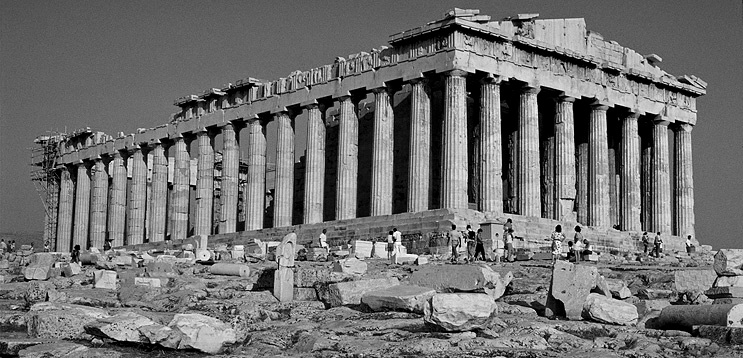
Socrates was Permanently Pissed: U Think on the Parthenon

Tomorrow night at 6:30pm at Brown's, U Think considers the Parthenon with geoarcheologist Scott Pike.
Built from 447-432 BCE, the Parthenon is considered the penultimate example of Doric architecture, Athenian self-determination and democratic ideals. Yet, despite its importance, there is still much to be learned about how the Parthenon was built.

Analyses of isotopes provide information about the origin of the Parthenon’s building materials. Tracing this ancient Greek supply chain sheds light upon the society’s complex social and economic systems.
We like to think of Socrates and Plato putting away the pints while they admire the temple!
Immanuel Kant was a real pissant
Who was very rarely stable.

Heidegger, Heidegger was a boozy beggar
Who could think you under the table.

David Hume could out-consume
Schopenhauer and Hegel,

And Wittgenstein was a beery swine
Who was just as schloshed as Schlegel.

There's nothing Nietzsche couldn't teach ya
'Bout the raising of the wrist.
Socrates, himself, was permanently pissed.

John Stuart Mill, of his own free will,
On half a pint of shandy was particularly ill.

Plato, they say, could stick it away --
Half a crate of whisky every day.

Aristotle, Aristotle was a bugger for the bottle.
Hobbes was fond of his dram,

And René Descartes was a drunken fart.
"I drink, therefore I am."

Yes, Socrates, himself, is particularly missed,
A lovely little thinker,
But a bugger when he's pissed.

Saturday, March 31, 2012

Drear and Beer: Keats and Shakespeare for National Poetry Month

More than just silly 80s-era googlegraphics and other pranks, April 1st is also the start of National Poetry Month!

So to get us started, here's a poem for our gloomy weather.

After dark vapors have oppress'd our plains
by John Keats

After dark vapors have oppress'd our plains
For a long dreary season, comes a day
Born of the gentle South, and clears away
From the sick heavens all unseemly stains.
The anxious month, relieved of its pains,
Takes as a long-lost right the feel of May;
The eyelids with the passing coolness play
Like rose leaves with the drip of Summer rains.
The calmest thoughts came round us; as of leaves
Budding—fruit ripening in stillness—Autumn suns
Smiling at eve upon the quiet sheaves—
Sweet Sappho's cheek—a smiling infant's breath—
The gradual sand that through an hour-glass runs—
A woodland rivulet—a Poet's death.


And here's a beerier poem!

The Winter's Tale Act IV, Scene II
by William Shakespeare

A Road near the Shepherd's Cottage. Enter Autolycus, singing.

When daffodils begin to peer,
With heigh! The doxy over the dale,
Why, then comes in the sweet o' the year;
For the red blood reigns in the winter's pale.

The white sheet bleaching on the hedge,
With heigh! the sweet birds, O, how they sing!
Doth set my pugging tooth on edge;
For a quart of ale is a dish for a king.

The lark, that tirra-lyra chants,
With heigh! with heigh! the thrush and the jay,
Are summer songs for me and for my aunts,
While we lie tumbling in the hay.


Prost!

Thursday, December 29, 2011

Beer Poetry: Eckerlen's Bad Santa and Auden on the Post-Christmas Lull

Was your Santa, like this one in an ad from 1903, an ol' booze hound?

It's hard to imagine today seeing an image of Santa like that, except in a "bad Santa" meme. (But we know about Santa's little helper.)

Hopefully you drank well and often over the holidays!

And now the pause.

In "For the Time Being," a Christmas Oratorio, written but too long for Benjamin Britten to set to music, W.H. Auden captures the hung-over flavor of the post-holiday lull:
Well, so that is that. Now we must dismantle the tree,
Putting the decorations back into their cardboard boxes --
Some have got broken -- and carrying them up to the attic.
The holly and the mistletoe must be taken down and burnt,
And the children got ready for school. There are enough
Left-overs to do, warmed-up, for the rest of the week --
Not that we have much appetite, having drunk such a lot,
Stayed up so late, attempted -- quite unsuccessfully --
To love all of our relatives, and in general
Grossly overestimated our powers. Once again
As in previous years we have seen the actual Vision and failed
To do more than entertain it as an agreeable
Possibility, once again we have sent Him away,
Begging though to remain His disobedient servant,
The promising child who cannot keep His word for long.
The Christmas Feast is already a fading memory,
And already the mind begins to be vaguely aware
Of an unpleasant whiff of apprehension at the thought
Of Lent and Good Friday which cannot, after all, now
Be very far off....

...In the meantime
There are bills to be paid, machines to keep in repair,
Irregular verbs to learn, the Time Being to redeem
From insignificance.
(Santa from a 1903 Eckerlen Saloon and liquors ad)

Wednesday, December 21, 2011

A Solstice Toast with Salem Beer and a Poem by Campion

Salem Beer sure seems to help Santa with the ladies - at least that's the suggestion. The scene looks rather pagan and the Santa more than a little creepy!
CHRISTMAS CHEER
And Salem beer are one and inseparable. Try a case this Christmas and you will find it the finest flavored, purest beverage you ever tasted. It is bottled by the Capital City Brewing Co., who supply it promptly to all who order.
Capital City Brewery and Ice Works, Mrs. M. Beck, Proprietress
Here's a winter poem by Thomas Campion:
Now Winter Nights Enlarge

Now winter nights enlarge
This number of their hours;
And clouds their storms discharge
Upon the airy towers.
Let now the chimneys blaze
And cups o'erflow with wine,
Let well-tuned words amaze
With harmony divine.
Now yellow waxen lights
Shall wait on honey love
While youthful revels, masques, and courtly sights
Sleep's leaden spells remove.

This time doth well dispense
With lovers' long discourse;
Much speech hath some defense,
Though beauty no remorse.
All do not all things well:
Some measures comely tread,
Some knotted riddles tell,
Some poems smoothly read.
The summer hath his joys,
And winter his delights;
Though love and all his pleasures are but toys
They shorten tedious nights.
Here's to the turning season and longer days again. Prost!

Monday, November 7, 2011

U Think Wednesday on the Invention of Jesus

Who would want to be limited to a single beer, brewed to the specifications of 3000 BCE, 1300 CE, or whatever model you might choose for the Ur-Beer?+

Nope, we celebrate the fecund excess of styles and variations today! There's never been a better time for beer.

In religion it's often the opposite: We mourn the loss of unity, worry about all the denominational variation, and long for a return to a moment of pristine origins when everybody was presumably on the same page.* The Truth is supposed to be one.

On Wednesday at Brown's Towne Lounge U Think features "the Sage of Galilee" and the latest scholarship on His foundational role in Christian origins.

It's timely since the presidential campaign of 2012 has put the origins of religion in the spotlight. How to explain this movement called Christianity and some of its descendents? And how should these movements inform contemporary politics?

Digging for the Truth

In a fabulous bit of cross-linguistic word play, the discovery of a Christian relic was called in Latin the invention of a relic. In-venio means to come upon, to find or discover. For us moderns the word "invention" points up the anxious matter of authenticity. Debates over golden plates and spectacles are far from new.

Here's the way one of the illuminators** of the Milan-Turin Hours envisions the discovery of the True Cross by Helena, Constantine's mother. She really found that cross. It may not be modern archaeology but the idea of digging was understood to lead to truth.

Nowadays digging also operates as a metaphor for textual interpretation. In post-Reformation Christianity, the text of the Bible, and not a relic or ritual, is the guarantor of authenticity. Scholars dig through layers of textual tradition in the Bible, in hopes of finding the foundation layer of Christian origins. The origin is assumed to be normative, the most authentic layer and commanding our assent. This leads from the Christ of Dogma to the Jesus of History.

About this, Albert Schweitzer wrote in The Quest of the Historical Jesus:
There is no historical task which so reveals a man's true self as the writing of a Life of Jesus. No vital force comes into the figure unless a man breathes into it all the hate or all the love of which he is capable. The stronger the love, or the stronger the hate, the more life-like is the figure which is produced. For hate as well as love can write a Life of Jesus, and the greatest of them are written with hate : that of Reimarus, the Wolfenbuttel Fragmentist, and that of David Friedrich Strauss. It was not so much hate of the Person of Jesus as of the supernatural nimbus with which it was so easy to surround Him, and with which He had in fact been surrounded. They were eager to picture Him as truly and purely human, to strip from Him the robes of splendour with which He had been apparelled, and clothe Him once more with the coarse garments in which He had walked in Galilee.
Though it's a totally different kind of passion than Jesus', the feelings behind Jesus research have been passionate indeed.

The torch-bearer of the modern quest is the Jesus Seminar.*** The Westar Institute runs the seminar's meetings, and just a few years ago they relocated to Salem, on the edge of the Willamette campus.

U Think catches up with the latest Jesus research on Wednesday!
Willamette University’s U Think series will feature Stephen Patterson, professor and historian who specializes in the origins of Christianity. He will present “The Historian’s Jesus: What scholars say about the sage from Galilee" on Nov. 9 at 6:30 p.m. in Brown’s Towne Lounge.

“Long before Jesus became the Christian savior he was a Jewish sage who provoked the masses and drew a crowd,” says Patterson. “Beggars loved him, and Romans feared him. In the end, he was executed for sedition. Historians now think they know why.”

Patterson is the George H. Atkinson Professor of Religious and Ethical Studies at Willamette University. He is the director of the Westar Institute, where he chairs the Jesus Seminar on Christian Origins. Patterson’s many books and essays address various aspects of the historical Jesus and Gospel of Thomas, among other biblical scholarship.
+ Or maybe like Pilsner Urquell. Biblical scholarship also has its Quelle, the Q-source.

* It's the old chestnut of the One and Many. The difference between hedgehogs, who know one thing, and foxes, who know many things. Or the difference between Athenian and Mancunian science, the difference between the physicist's search for a unified field theory and the biologist's search for new species.

** If you're into art history, many scholars have conjectured that this image is by Jan van Eyck.

*** Here's the Jesus Seminar Drinking Game™:

In the past, the Jesus Seminar voted on the sayings of Jesus, trying to determine whether they were authentic, similar to something Jesus said, inauthentic but related to something He really said, or totally inauthentic and from a later tradition. They used red, pink, grey, and black beads.

U Think can turn this into the best parlor game ever! If U Think the saying is real, you must finish your beer! If U Think it's similar, you have to drink half your beer. If U Think it's inauthentic but related, you have to take a sip. And if it's fake, you don't have to sip.

You will know the skeptics by their sobriety! And the enthusiasts will be rolling wholly on the floor.

Monday, October 31, 2011

Beer for Halloween

Whether you call it Halloween, All Saints and Souls Days, Samhain, or DĂ­a de los Muertos - it's a strange amalgam of carnival and loss. Take a moment to toast the good times and the dead and haunted in the next couple of days. Life is fragile and fleeting.

Here's a Halloween poem.
All Souls' Night, 1917
by Hortense King Flexner

You heap the logs and try to fill
The little room with words and cheer,
But silent feet are on the hill,
Across the window veiled eyes peer.
The hosts of lovers, young in death,
Go seeking down the world to-night,
Remembering faces, warmth and breath—
And they shall seek till it is light.
Then let the white-flaked logs burn low,
Lest those who drift before the storm
See gladness on our hearth and know
There is no flame can make them warm.
For the fun, don't let your Halloween Hangover stop you. Toast the Day of the Dead with an Abominable Winter Ale at the Taphouse.
The Hopworks Urban Brewery (HUB) party is coming to the Taphouse November 1st with special guest brewer Jaime Rodriguez. This party will be staring later in the evening than previous parties and will run 7:30 to close.

We’ll have HUB swag to give away. A six HUB beer taster tray for $7. We’ll be running happy hour prices on all HUB draft beers through closing. Free HUB glass with your first HUB purchase while supplies last, one per customer please.

Draft beers will be: Batch 1000 ESB Anniversary Ale, HUB Lager, Abominable Winter Ale and Seven Grain Stout. HUB focuses on Organic beers that are produced in their environmentally friendly brewery in Portland.
And since it's not all fun-and-games, think about the lost, especially those lost deep in the institutions of Salem.

As the Prison and Courts grapple with a Capital Case even today, consider all those executed, some of them quite possibly innocent. But whether guilty or not, there's a long, long trail of loss and sadness.

And consider those alone who, without family by their side in dying, and without family after death, still endure the lonely cannister.

Saturday, October 29, 2011

AIA Oregon Top 25 List Omits Salem Landmarks

Over at Portland Architecture and Southwest Oregon Architect, folks are talking about the Oregon chapter of the American Institute of Architecture's 100 favorite buildings.

Neither top 10 list has anything from Salem. Nor does the top 25 list on the AIA website. In truth, Salem probably doesn't have any top 10 architecture - but you know, the Capitol has to be on the top 100 list. Maybe the Supreme Court building? First Methodist? What do you think? What are the most architecturally distinguished buildings in Salem?

Here's the top 10:
Timberline Lodge, Mount Hood (1937)
William I. “Tim” Turner, Gilbert Stanley Underwood

Mount Angel Library, Mount Angel Abbey (1970)
Alvar Alto

Commonwealth Building, Portland (1948)
Pietro Belluschi

US Bancorp Tower, Portland (1983)
Skidmore Owings and Merrill and Pietro Belluschi

Pioneer Courthouse Square, Portland (1984)
William Martin

Portland Central Library, Portland (1913)
A.E. Doyle

Gordon House, Silverton (1964)
Frank Lloyd Wright

Memorial Coliseum, Portland (1960)
Skidmore Owings and Merrill

The Watzek House, Portland (1937)
John Yeon

Crown Point Vista, Corbett (1918)
Edgar Lazarus
What's the top Salem building?

(And where are the Salem architects in the conversation!?)

Also, on architecture, it's nice to see Waterplace merited LEED Platinum certification. It'll be really interesting to see how the building is viewed over time!

Saturday, October 22, 2011

Downtown Welcome Maps' Amuse-Bouche: History on the Flip Side

You may have noticed a bunch of the new signs have gone up. Naturally, we thought a review of the historic part was in order!

Somewhere we think we read there are eight signs, but we've found only seven. On one side they have a stylized map of downtown. On the other side is a little history lesson with historic photos and captions. The frames are brightly colored and topped with a whimsical icon.

The first thing we noticed is the history's always on the same side, the north-facing side. This means sometimes you can't flip back-n-forth easily between a modern view and an historic view. We wanted the ability to rhyme in time with our eye!

It wasn't long before we realized the city installed the historic photos away from the sun so that part fades more slowly than the map, which presumably will be easier to replace.

But this also means that you might have to squint into the sun to look at them. The maps, of course, are easy to see with your back to the sun. Since they're the main course, and the history the amuse-bouche or dessert, the priority is probably right.

Still, protecting the historic images in this way makes for some goofy views. If they win the pragmatic and preservation test, sometimes they lose the information test.

We'll do one batch today and another batch some other time.*

The General Layout and Plan

The top half of each sign tends to be a large historic photo and caption. This gets varied: the image is sometimes printed full bleed, past the edges; other times the image enjoys generous margins. The bottom half gets broken up in different ways, some more regularly ordered in columns, some a little more random across the "page." Each sheet seems to have a footer. The overall plan is flexible.

The photos vary unevenly. Some are wonderfully detailed at the enlargement. Some are obviously reproduced from newsprint half-tones. Still others are badly jaggy from being enlarged too much. One on the sign at the Reed Opera House is particularly awful.

The idea seems to have been to select historic trivia, much of it related to the location of the sign - though as we will see, this breaks down. There's not an overall interpretation of Salem history or a narrative that links sign to sign. The lack of a master interpretation is ok, but something to pull the viewer and visitor to the next sign might have been nice - a teaser, to create interest. Maybe a sort of scavenger or easter egg hunt?

Strangely, there's nothing about the walking tour on the signs. You'd think the signs would encourage people to stop at Travel Salem or other places for a walking tour brochure. That seems like an unfortunate omission or lack of coordination.

It's not clear, in fact, that the sign placement consistently thinks through the logic of pedestrians, whether walking downtown or driving downtown and then walking. There is, then, a basic tension between places important in 19th century Salem, and places a 21st century Salemite is likely to walk. The signs don't always synchronize the two.

Typography

Since the design is flexible, the most consistent element might be the type. Somebody likes the smart fonts of emigre! They're a terrific choice for something intended to bridge old and new, and meant to offer little tastes of amusement, delight, and learning.

The main text font is an excellent choice. Though it looks vaguely antique, it's not antiquarian. But neither is it contemporary.

Indeed, it looks like Mrs Eaves from emigre fonts, a modernized revival of Baskerville. It's a modern update of a classic font from the 18th century, and a lively choice for historical signage. Nothing stuffy here!

Fairplex, also from emigre, appears in the footers and a few middle headlines. Its slightly angled serifs are also terrific. As with Mrs. Eaves, Fairplex suggests an older face, this time a 19th century face, like something on a "wanted" poster in the Wild West - but with that modern twist, again.

Less successful are the upper headers. The ones in Engravers don't quite work for us.

If the Mrs Eaves has a nice vintage air, the Engravers puts on airs. It's fusty and stuffy, monocled and bankerly. Not a good match for the martini olives, dog, eye, hand and other icons.

We wonder if a non-serifed font might have made for a better contrast with the text face and also been somewhat more legible than the Engravers. At the very least something less rigid and more inviting. That's the great thing about Mrs. Eaves: It has this human whimsy and fineness without also being fussy. She wears funny plaids and hats sometimes!

In the pictures you may have also noticed that the "B" in "Buildings that Move" is different from the "H" in "Historic Waterways." The initial capitals vary from sign to sign, and some of the typographic elements don't seem to have been used much in other signs. There was maybe a missed opportunity for a tighter theme-and-variations approach.

In the end it's clear the history trivia is a bit of a throw-away, an ode to serendipity rather than part of a vision or program. It's tasty, but it's only an amuse-bouche to whet your appetite for more.

Here are four signs, and observations nit-picky and not.

Church and Center

For history, of the four this was our favorite. The site of the old high school isn't much known, and this commemorates it nicely. Though when you look at the sign, you are looking across the street at the wrong block. You should be turned around and looking at the Meier & Frank/Macy's parking garage!

(1905 Salem High School, Salem Library Historic Photo Collection)

The other part about the sign's location that might be a little odd is that it's next to the entry to a parking garage and ugly chain link fencing. At the corner are a couple of banks and the shabby Greyhound station is just up the street.

It's not adjacent to a high-traffic pedestrian location, but instead is adjacent to a high traffic auto location! If it is intended to lure people out of their cars, it's too far from the driveway - and to the east, away from major destinations. If it is intended to be seen by people walking around, locating it next to the main Macy's entry on High and Center might have been better. Since there aren't many storefronts on Church in this area - the record store a block away looks like it's closing - and since Center street is busy with cars, the logic of site placement for pedestrians is not clear here.

Church and Ferry

Highlighting the old mills and the significance of the waterways was neat - but the stream of mystery was missing from a map purporting to show the waterways in the 1880s!

On this detail from the 1895 Sanborn map, you can see the mystery waterway along Mill Street, the the northmost arm of a trident at Church Street, where the Pringle, Shelton, and mystery creeks converge.

The map on the sign shows the confluence only of Pringle and Shelton creeks.


It's also directly across the street from First Methodist, surely on the shortlist for most important historic buildings in Salem. It is odd that a sign in this location doesn't acknowledge that in any way.

Still, the placement here, at a sort of gateway from Willamette, the Parkway, and the Bush Park/Gaiety Hill neighborhood makes some sense. People are likely to be walking here.

High and State

Here's where the sign orientation gets tricky. To look at this sign you look south down High Street, but the view in the photo is west down State Street, so you have to turn 90 degrees to the right.

Look closely and you'll see the mystery "bathroom vents" on the old Courthouse grounds! (This photo looks like it's from later in the 1930s, so it muddles rather than clarifies the question of date. Strangely, it's from Mission Mill, and one wonders why they didn't reproduce it on their own blog post, since it's much higher quality than the photo they used.)

And though the headline talks about the theatres, the theatres are to the south. They aren't in the photo!

There's a pretty significant disconnect between text, image, view, and site placement here.

At the same time, by the Courthouse and across from the nascent "restaurant row," it is a good high-traffic walking location. The apparent mandate to orient the photos on the north side does interfere with good information design, however.

Liberty and Commercial

Though the information on this sign is nice, the location is lousy. This is a total location fail!

When you look at the photo, you also look south down Liberty. But the photo shows Commercial! Why didn't they align the location with the photo, either both on Liberty or both on Commercial? Moreover, the view is north up Commercial from the corner at State, rather than an equal view down south from the Corner at Chemeketa. That's complicated: Your orientation is turned around 180 degrees and displaced two blocks south and one block west. It's a knight's move in chess! This sign is too random and general, insufficiently responsive to site.

This matters because right at the mall entry, this is a very good walking location. This is a good site with a mismatched sign.

The brick, reading "Convict Made, 1912, O.S.P." from the Oregon State Penitentiary is a nice detail, though. That's one of our favorite bits, and something completely new to us.

So do you have a favorite sign or observation about them?

* Or maybe not. It's possible another round would just be otiose. If you're curious, they're at the Grand Hotel, Riverfront Park, and the Reed Opera House. So where's that eighth one?

Tuesday, October 18, 2011

Indie Rock, but no Beer, at the Library

Too bad you can't drink beer in the library!

Tomorrow night the reading series at Willamette will have a new wrinkle: Indie Rock.

Al James of Dolorean will talk and even perform a little in the Hatfield Room at the Willamette library. Presumably he'll perform some from his recent record, The Unfazed, released earlier this year.

James is a WU grad and the talk's at 7:30pm.

Monday, September 12, 2011

Homes for the Lost and the Living: Mid-Century Funeral Architecture

Walking around town you'll doubtless have seen the mural of Theda Bara as Cleopatra.

It was painted in 1984 by Jim Mattingly. Perhaps for naive and sentimental reasons, we find ourselves drawn to his landscapes more than his portrait busts. At least two of them are on essentially permanent display around town.

One of them, Stump's View, was given to Willamette by Elisabeth Walton Potter, who was in the news recently, in memory of Henry and Ellen Fawk, who built the lovely house in the Fairmount neighborhood.

Another, Airlie Autumn, is in the Salem Conference Center's permanent collection, purchased as the winner in the Oregon Artist Series, Mayor's Invitational 2008.

The paintings are conventionally pretty, and they might not show absolutely distinctive landscape features like Mt. Hood or the Three Sisters - and yet they show the there there. A genius loci presides over them and Mattingly's act of painting.

While thinking about St. Mark's, walking around downtown, and staring at Cleopatra, we realized that Salem has some other interesting mid-century buildings. They aren't fancy or even perhaps all that lovely, we're not talking grand architecture, but in an unobtrusive, even subtle, way they are odd and interesting. They have some charm, an element of minor beauty. And they don't seem to be tiring as quickly as some moderne or googie buildings.

Maybe you pass by them and don't really see them? Because of the businesses they house, almost certainly they are by design a little quiet.

(So we read these buildings as expressing a quiet taste. But how did contemporaries read them? Were they regarded as dull and boring when built? Or did they represent leading and innovative architectural fashion for Salem? Our speculation may be ahistorical and off-base!)

The Barrick Funeral home is a hatbox. It has the most amazing basketweave wrap on its brow - like a lid a hatbox! Or bangs on a face. Otherwise it's just a square box - with a sagging roof on an older parking structure.

The building is so quiet - even sleepy - but the basketweave makes it texturally alive. That one detail elevates it.

The Barricks you may recognize from North High's baseball field and the historic photo cards.

Across the street from the library is the Virgil T. Golden Funeral Home.

Its massing looks like it's built of legos or building blocks! But then you see that many of the corners are rounded and filled with translucent glass! So there's this dynamic interplay of square and round, and opaque and translucent. And then there's the green oak tree, growing up and out over the horizontal and beige mass of the building. It's a large sphere over the rectangular blocks. The essential vocabulary is simple, very basic, but it might actually be one of the most dynamic buildings in the city, shimmering with these subtle contrasts, all the more expressive because of its simplicity.

The funeral homes might wish to be wallflowers, inconspicuous in the urban fabric. Death is pretty much always an unwelcome guest. In the face of that, these buildings offer unexpected charm. We don't want to overstate their brilliance, but at the same time, they are lively and odd and interesting - lovely in their own way.

Sunday, August 14, 2011

Is St. Mark's the Most Beautiful Church in Town?

Generally we worship at the pub and bar counter. We have an altar and celebrant, libations too.

But what about actual churches? What is the most beautiful church in Salem?

We propose St. Mark's Lutheran on the corner of Marion and Winter. Its Belluschi+Wright blend of modernism and prairie school strike us as the most lovely church building in town. Its rhythm, proportion, and harmony are a most pleasant balance of old and new, of jaunty and peaceful. The brick is warm without being at all severe, the windows and massing shape the space in lively ways, and the gothicky bas-relief of Jesus stresses the Good Shepherd and not the Crucifix. And it still has energy, refusing to be tired or dowdy or dated, from which some mid-century design now suffers. Indeed, it has just past the 50 year threshold for listing on the National Register, and we wonder if it might meet the other criteria for significance.

The congregation is almost 100 years old. In 1957 construction started on a new building and in 1958 it was dedicated. Harold E. Wagoner of Philadelphia designed it.

According to the Philadelphia Architects and Buildings database:
Harold E. Wagoner was born in Pittsburgh, PA, and received most of his architectural education at the Carnegie Institute of Technology (B. Arch. 1926), with a return to architectural education in 1933 when he enrolled at the American Ecole des Beaux-Arts in Fountainebleau, France. Immediately after graduation from Carnegie he was employed by the Methodist Bureau of Architecture (1926-1933; Sundt & Wenner), and this experience inclined his mature career toward ecclesiastical design, an area in which he became a specialist. Writing in 1983, Wagoner declared: "My firm is one of the few, perhaps the only one in the U.S. which has devoted all its efforts to Religious Architecture. We have had commissions in 36 states. . . . We have designed over 500 religious buildings."

During the years in Philadelphia working for the Bureau Wagoner was associated with the office of Thomas & Martin (1936-40), followed by a stint of work with Wenner & Chance. His connection to Walter Thomas would be cemented in the 1940s when Wagoner became Thomas's partner in Thomas & Wagoner (1944-1948), after serving as Chief of the Camouflage Unit, U.S. Army Engineers during World War II (1942-1944). In 1948, however, he organized his own independent office and continued in operation well into the 1980s. During this period, he was also associated with William C. Chance. Wagoner's office was succeeded by Henry Jung.

Prominent in the field of Protestant church design, Wagoner contributed a number of articles to Faith & Form. He also received several awards, including in 1958 an Award of Merit from Carnegie Institute of Technology. Within the awards granted by the Church Architecture Guild of America, Wagoner dominated in the 1950s and 1960s.

Wagoner was also active in the Philadelphia Chapter of the AIA, serving on the board of directors from 1959 to 1961 and as vice-president from 1961-1962. He gained Emeritus status with the AIA in 1976. He also served as Chairman of the Commission on Architecture, Lutheran Society of Music, Worship and the Arts and President of the Church Architectural Guild of America.
Though this doesn't list it, in 1968 he also became a Fellow of the AIA. His AIA membership file contains a long list of publications, addresses, and church designs. Clearly he was a big deal in church architecture. The google suggests he worked in a broad range of styles, from neo-Gothic to modernist, and it seems he took special pride in designing from and following each congregation's sensibility and theology rather than imposing his own style.

So that's our candidate. What's your choice for the most beautiful church in Salem?

Sunday, July 17, 2011

Digging in the Depression: Lord and Schryver's New Deal

For local history buffs the most interesting summer topic will surely be the reconsideration of the private garden and public park work of Elizabeth Lord and Edith Schryver.

A while ago over at On the Way, Bonnie Hull offered a fascinating preview of the Lord & Schryver show at Hallie Ford, which she co-curated with Sharon Rose, and more recently a note about a garden tour.

Based on these previews, though, more than the gardens it's the watercolors and graphic design that look eye-opening. They look terrific, and the preview hints at a show of minor revelation - maybe more. There's the prospect for some Wow! That's pretty cool.

But the dates Lord & Schryver were active pose another question.

From On the Way, here's the watercolor plan for the Jarman House* right by the library on Gaiety Hill. It's lovely. Its date is also 1929.

The Deepwood commission followed shortly in 1930.

And what else started in 1929?

As we all struggle ourselves with the Great Recession, isn't it interesting that so much of the Lord & Schryver legacy apparently took root during the Great Depression?

In the spring of 1932 as Herbert Hoover's term in office was winding down, and unemployment was around 25% (so three times the 9% we have now!), Lord & Schryver wrote a series of articles for the Oregonian on improvements for an "average-sized city dwelling."

Right.

Who in 1932 could afford significant replanting, let alone professional landscape architecture services?** In some ways this "average-sized" lot represents a shift from the large suburban estate for Lord & Schryver, but it's average only in name.

We look forward to learning more about the "cultural landscape" Lord & Schryver did so much to influence. But we also have to ask, just how narrow a slice of culture are we actually talking about?

In his book Architecture: The Natural and the Man Made, Vincent Scully has written of the relationship between gardens and forts in 17th century Europe. He says that "the idea that the arts of fortification and of landscape architecture were almost the same was quite a logical one in the seventeenth century." And he observed that "the resurrection of the garden" in the early 1900s was also a rehabilitation of Louis XIV.

Surely it is no coincidence that Lord and Schryver met on a tour of European gardens!

(Vauban's fortification at Huningue, from Wikipedia)

To say the Lord & Schryver gardens are the products of wealth, indeed emblems of conspicuous consumption, in the middle of the Depression is not to deny their beauty. Nor is it to deny value - the creation of living, beautiful systems is a genuine act of creativity in so many ways. But we should remember they weren't victory gardens defending against the Depression, either.

We hope also that social history is not neglected in the recovery of Lord & Schryver's legacy.

* We think of it, of course, as the second Lachmund House!

** Harry Stein (in his pictorial history of Salem) suggests that with a diverse economy, Salem "endured the national Depression better than did many small cities," but it difficult to see this as much more than local pride and boosterism. He observes that Fred Meyer and Sears added stores in Salem early in the 30s, and that Salem added more people than did Portland at the same time.

Between 1930 and 1940, Salem's population increased by 18% from 26,266 to 30,908. Calling Salem a "small city" seems generous, and it's hard to know what an increase of 4,642 means. Portland was 10x larger, about 300,000.

In any case, WPA projects like the new State Capitol building, the State Library, the State Forestry Building, and the Portland Road rail overpass would certainly have a multiplier effect in the economy. But that's a government stimulus!

Friday, July 8, 2011

First There was Science Pub, Now U Think Ponders Lady Gaga Tuesday!

Check it out! You heard rumors of a "Humanities Pub"...well, here it is. From the release (no time for more):
Willamette University will kick off its U Think pub series on Tuesday night at Brown's Towne Lounge with a talk about Lady Gaga. Beginning at 6:30 p.m. each second Tuesday, the monthly series will feature topics from the sciences and humanities.

“Science Pub has been a fun way to share Willamette faculty expertise with the community, and OMSI has been a fantastic partner,” says spokesperson Adam Torgerson. "Given all of the interesting work our professors do across the university, U Think provides an opportunity to bring a more diverse series to Salem.”

On July 12, U Think will feature Assistant Professor of Rhetoric and Media Studies Amber Davisson. She will discuss the strategies Lady Gaga uses to craft her image and will consider the message underlying Lady Gaga's precipitously high heels.

“While many celebrities today make the news for drug abuse or relationship problems, Lady Gaga has shown an impressive ability to manage her image and stay on the front page,” says Davisson. “In the past few years, she has boasted more Twitter followers than the president and has found a place on Forbes’ and Time’s lists of most influential people.”
Nicely done Willamette and Brown's Towne!

Sunday, June 26, 2011

Addenda: Salem School Architecture and the Legacy of the Pughs

One of the small mysteries in Salem architecture is the identity of the "old Salem High School" attributed separately to Fred Legg and to Walter D. Pugh towards the end of their lives.

The mystery is small because, well, it's really probably not all that important. But the accounts are more than a little unclear, and the curious want to know! Our conclusion is that Legg designed no high school and the 1905 old high school is Pugh's. (This is also an especially baggy and meandering note, so be warned.)

Portland School Buildings in the Early 1900s

Over at Portland Architecture, Brian Libby has been running these terrific profiles of the Portland school buildings. Two of them, ones on Grant and Roosevelt, help point the way to filling in details on Salem's school history.

About Grant, Libby quotes from the Portland Public Schools own architectural history:
Beginning with the construction of the main building and a gymnasium in 1923 and closely followed by an additional auditorium unit and two wings between 1925 and 1927 Grant High School was part of a dramatic building program begun by the Portland Public Schools in the early 1900s. Two of the most influential district architects during this period included Floyd Naramore and George Jones, who designed a majority of the schools from 1908 to 1932. Due to the large number of projects conducted by the district in the early 1920s, however, the school board hired Knighton & Howell, a Portland architectural firm to create the designs for Grant High School.
Grant's design doesn't concern us directly, but a more-or-less concurrent design does. About the same time, in 1922, George Jones,
reused most of the architectural drawings from Franklin High School to lay out the plans for Roosevelt.
A decade earlier Naramore had designed Franklin. In 1919 he moved to Seattle, but before doing so Naramore designed 16 Portland schools, including the Kennedy School, whose single story layout was a response to fire safety.

North High, Parrish and Leslie

It turns out that what we might think of as a Portland "pattern book" for schools was useful here in Salem.

William C. Knighton is known in Salem for some really lovely buildings, perhaps the most elegant in Salem: the Richardsonian Romanesque Capital National Bank, Deepwood, the Bayne building, and the Supreme Court building - historic drawing here. (There are many others, and a full list would be useful!)

A tip from reader RC pointed us to his school designs, a group of more utilitarian works. The contracts for Parrish and North were substantial, if not especially stylish, commissions. He was also involved in the design of Leslie.

RC shared an image of North, on the left in the composite, from the October, 1940 issue of Architect and Engineer, in an article "Current Trends in Oregon Architecture." And you can clearly see the common Colonial Revival pattern in North and Roosevelt. If Jones patterned Roosevelt on Naramore's Franklin, it seems likely that Knighton modeled North on Roosevelt. It wouldn't be at all surprising to learn that the internal plans are similar - though the Depression-era WPA contract for North yielded a plainer facade than the more ornamented one of Roosevelt from the roaring twenties.

Parrish is also by Knighton and Howell - Robert West had noted this and it wasn't much in doubt, but it was something we could have confirmed easily, simply by walking by the front door and looking at the building dedication plate!

Finally, there's Leslie. It was never identified as a "high school," but we wanted to make sure Legg or Pugh wasn't involved. Its architectural pedigree is a little odd. There's no obvious cornerstone outside, but perhaps it was swallowed up by South High's theater and music wing that wraps around the northwest corner of Leslie. The Statesman of July 14th, 1926 has an article on the selection process: With a headline "BOARD DIVIDED ON ARCHITECTS," it continues "Knighton & Howell, Freeman & Struble Asked to Collaborate." Neither Legg nor Pugh had submitted a proposal. It seems that Knighton & Howell hadn't either, but the school board liked the Parrish work well enough that they didn't want to leave the commission solely in the hands of the Salem firm of Freeman & Struble. Or perhaps it's more accurate to say that the school board needed for political reasons to carve out room in the commission for a local firm. Either way, the building may be something of a red-headed stepchild, a design no one wished to claim.

The 1905 Old School is a Pugh

So the only "high school" buildings left for Pugh or Legg are the 1905 Salem High School and the 1887/1893 East or Washington School (at least two dates are attested).

The paper gives a clear trail on the 1905 and confirms it is Pugh's!*

On February 27th, 1905, the Capital Journal ran a piece about the school board awarding the school design contract to Pugh. At that meeting, and in the paper throughout March, there is much grousing about the potential for graft in a no-bid contract. In the March 20th paper, the school board formally accepted the plans, with Dr. Byrd first taking exception to the inclusion of a gymnasium and shower rooms. These were struck from the plans. No Physical Education for the good doctor! The plans did, however, retain separate "bicycle rooms" for the boys and girls.

Construction bids would be accepted at Pugh's offices and opened on April 1st, the building to be completed by September 30th. Pugh estimated a wood building would cost $34,000 and a pressed brick $41,500.

By summer, Fred Legg had joined Pugh's practice. On August 29th a notice appears announcing "bids will be recieved at the office of Pugh & Legg" for a "one-story frame school building to be erected in school district No. 61, Polk County." District 61 was in Airlie, and this two-story school building in Airlie (courtesy of Oregon Hoops History) could be it, though of course it's got an extra story (and solving this mystery is another story itself! and may be out of the CT purview).

So it seems pretty clear that Pugh drew up the designs for the Salem High School, and it was likely that Legg was involved in supervising the school's construction. It should not surprise us, then, that memories were fuzzy at the end of Legg's life, and that some or all of the credit for the school might go to him. But Pugh is very clearly the designer.

The school was dedicated on January 1, 1906. Welch and Mourer were the builders, and they also built the "Klinger and Schreiber Block."

This saloon ad from August 1904 references the Klinger block on the alley, between the Schreiber building and the Bligh. Another reference from about the same time mentions old, decayed wood, so it's not clear that at this time in 1904 there's a brick building there. More mystery!

East/Washington School

Back to the schools, the main remaining question is the 1887/93 school (at top).

Pugh's father, David Hall Pugh, is buried in the Pioneer Cemetery, and the biography they cite there is helpful.
Mr. Pugh became one of Salem's foremost contractors and builders and left many beautiful monuments to his handicraft.
He built the E. N. Cook mansion**, that has graced Court Street for over half a century. He also built the old Cumberland Presbyterian and the Presbyterian churches, besides many other public buildings and good residences of the early capital city. Always his work was of the best and he was heard often to remark that he was not afraid when his work was inspected.
It also notes that he
was a member of the immigrant train of 1845 that brought his father, David Pugh, Sr., his mother Jeanette and brothers William, John, Andy, Silas and sister Mandy Anne and a little sister to Oregon.*** The brother William was captain of the train, and other families in the caravan were Alva Smith, Commodore Rose, whose wife died on the plains and whose children, Commodore, Jr., Sarah and Nancy, went to live in the Pugh family.
Walter's uncle, William, appears in school history as the original superintendent of District 24J.

So it seems likely that Walter's father, David Pugh, Jr., was involved in the design and construction of East School. The Cooke mansion looks like a finer, more delicate version of the school, even! But we are not sure to what extent this reflects stylistic patterns common to the era and to what extent it might express a personal style of the Pughs. The Piper/Boothby Courthouse looks similar, too. (Walter himself was not even 20 at the beginning of construction for the school, and seems therefore too young to have led any of the phases, though he might certainly have labored on the project. On the other hand, by 1888 he designed the Shelton-McMurphey House in Eugene, and the National Register form suggests he was active as a carpenter in 1880 as a teenager.)

If it turns out not to be a Pugh, our old friend Wilbur Boothby is a likely suspect.

Construction for the school ran from 1883-87. (The 1893 date for a Pugh school cited in the OSH nomination form is wrong and is most likely an error for 1905.) There were financial difficulties and construction was delayed at least once. By fall 1886 construction was complete enough for students and teachers to use the building, though it didn't seem to be finished until 1887. We hope to have more on the school.

* Well, after we got into this a bit, we found an old-media note that would have simplified things! Drawing on her earlier 1932 dissertation, Constance Weinman contributed "A History of the Salem Public Schools, 1893-1916," to Marion County History, XIII: School Days I, and said clearly that Pugh designed the school. Weinman also added that among the chief cities in the Willamette Valley, Salem was late to develop high school education; she also felt Salemites were generally dismissive of education. It's an interesting antecedent to the So-Lame/Salemia meme.

** The Cooke-Patton house was razed for the State Library and Capitol Mall in 1939. Virginia Green's note on 1938 has some of the history and notes on the passing of Luella Patton in 2007.

*** This piece references a Reverend William Pugh as the patriarch, not David Pugh, Sr. The biographical material cited here in the cemetery records is in part compiled from the oral histories in the Book of Remembrance of Marion County, Oregon Pioneers, 1840-1860 by Sarah Hunt Steeves (1927). Drawing on material from Catherine Entz Pugh, the wife of David Hall Pugh, it contains several short biographies of Pugh family members, and identifies the father as David, Sr. The Reverend William must be interpolated from some other source.